Showing posts with label morality. Show all posts

Saturday, April 30, 2022

You tell me that it's evolution, well, you know...

It has been a frustrating several decades for science since John Whitcomb and Henry Morris published The Genesis Flood in 1961, the book that laid the groundwork for modern biblical literalist creationism. Those authors just flatly denied what science had appreciated since the early 1800s: that the earth is very old, and has been populated at different times by diverse creatures that were quite different from living ones, although frequently resembling them. While there has always been religiously-based resistance to Darwinism, it was a rare anti-intellectual who dared venture into “young-earth creationism”. Even William Jennings Bryan, Clarence Darrow’s antagonist in the famous Scopes trial, volunteered the fact that he was an “old-earth” creationist, to the surprise of both sides in the courtroom. 
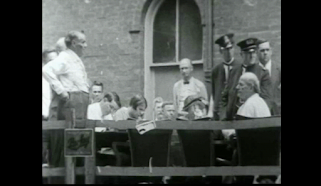
DARROW:  Would you say the earth was only 4,000 years old?
BRYAN:  Oh no, I think it is much older than that.
DARROW:  How much?
BRYAN:  I couldn't say.
DARROW:  Do you say whether the Bible itself says it is older than that?
BRYAN:  I don't think the Bible says itself whether it is older or not.
DARROW:  Do you think the earth was made in six days?
BRYAN:  Not six days of twenty-four hours.
DARROW:  Doesn't it say so?
BRYAN:  No, sir.

In other words, “young-earth creationism” was too stupid even for William Jennings Bryan in 1925.

The Genesis Flood, on the other hand, began in 1961 with the premise that the Bible relates literal history; the Bible says that the Earth is merely thousands of years old; therefore it must be; and therefore all species lived at the same time, not so long ago. Almost as an afterthought, evolution must be false as a simple consequence of this biblical revisionism. This begged the question of how animals actually came to be fossilized, short of having been magically petrified by the visage of the gorgon Medusa; or how particular fossils came to be very consistently deposited in similar formations of rock layers, in spite of all that sloshing of the flood waters. It left you to wonder how the modern lemurs made it to Madagascar, and nowhere else; or how the koalas made it from Mount Ararat in the Near East all the way to Australia, without eucalyptus forests in between.

Most importantly, though, The Genesis Flood enjoined the reader to simply reject lots and lots of real and scholarly geology in favor of some dopey alt-geology. Where might such a bizarre suggestion come from? Saying that science has gotten something wrong is not in itself threatening. After all, when we teach that science is self-correcting, that is quite specifically what we mean: Science has gotten something wrong and we are correcting it.

The context of modern biblical literalist creationism bears some examination. Today it is fashionable to regard creationists along with anti-vaccinators, anthropogenic climate-change deniers, and flat-earthers, as part of a vast conspiracy of stupid. But there are two problems with this view. First, science is, and has sometimes famously been, wrong. When American geneticists of the 1920s said that we needed to sterilize the poor and restrict immigrants on account of their “bad germ-plasm,” it was the anti-science mobilization of the civil libertarians, social scientists, political conservatives, and religious Catholics that we can admire in retrospect for standing up to the geneticists. And second, we don’t know the degree of overlap among the anti-vaccinators, anthropogenic climate-change deniers, flat-earthers, and creationists.  Although some of them rationalize their beliefs with Bible verses, only the creationists are actually religiously motivated. In fact, even the creationists think the flat-earthers are nuts. 
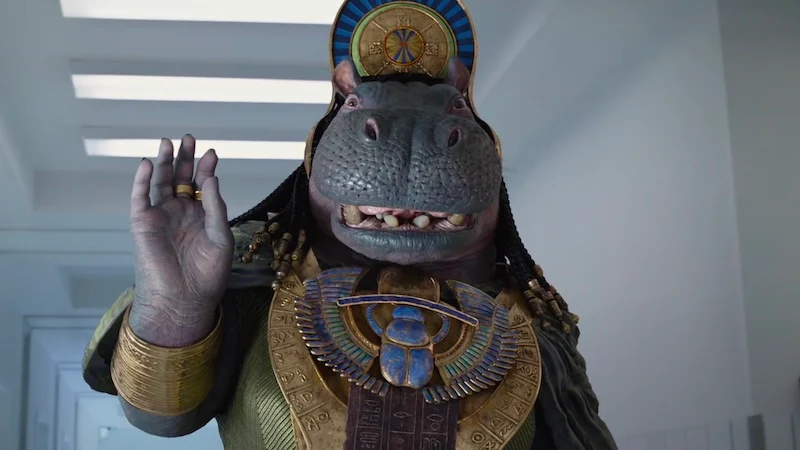
St. Augustine, a Hippo
In other words, creationism represents a special kind of anti-science, rooted in a particular hermeneutic treatment of the Bible: selective biblical literalism. It’s selective because, as even St. Augustine of Hippo  recognized, when you read that Adam and Eve’s “eyes were opened” after eating the fruit in the Garden of Eden, you simply can’t imagine that they had been walking around the Garden with their eyes closed, bumping into things. It has got to be a figure of speech, not to be taken literally.

There is a different context for looking at creationism, however. Scarcely a decade before The Genesis Flood, the scientific world was scandalized by a Bible-based book of a different sort. It was called Worlds in Collision, written by psychoanalyst named Immanuel Velikovsky.
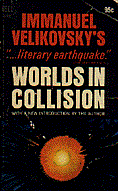
Velikovsky was not a literalist, nor was he concerned with the book of Genesis. His interest lay in Exodus, but his biblical focus was rooted in an equally ridiculous premise: Since all myths and legends are ultimately based upon real events (rather than just being stories, like Cosette and the Thenardiers, or Oliver Twist and Fagin, or Luke Skywalker and the Death Star) then what actual circumstances might have been the inspiration for the miracle-infused biblical Exodus from Egypt? In particular, what might have started things off by turning the Nile to blood, Plague Number One of Ten – or at least to something that Bronze Age yokels might have mistaken for blood? The subsequent plagues of Egypt would also receive naturalistic explanations too – frogs making their own amphibious exodus from the now-toxic river, then hosting insect vermin as disease made its way up the food chain, eventually culminating in mass deaths – hazily misremembered and misrecorded as merely the Egyptian first-born.

But what started it off, turning the Nile river to blood?

Velikovsky had an answer, and peppered his biblical exegesis as well with tendentious renderings of ethnographic and archaeological texts. What had turned the Nile red and undrinkable was red matter that had fallen into the Nile from the surface of the planet Venus. How did it get there? The planet Venus had just come into existence, having been expelled as a comet from the Great Red Spot of Jupiter; and was shooting through the solar system, eventually banging into Mars before both planets settled into their separate orbits just a few thousand years ago. It was an ingenious theory, with only one obstacle in its way: astronomy.  So Velikovsky invented his own alt-astronomy and settled into the #1 slot of the New York Times best-seller list in the Spring of 1950.

Needless to say, astronomers did not take this at all well. Sadly, though, they did a spectacularly poor job of engaging with Velikovsky’s work, beginning with threatening its publisher. Their fulminations were properly dismissive, necessarily technical, sometimes ad hominem, and occasionally incoherent. Eventually, though, Worlds in Collision faded from view, and today you can generally only find Velikovsky’s ideas by searching for them on the internet. Nevertheless, both Worlds in Collision and The Genesis Flood prominently cast themselves against science, and in favor of their particular interpretations of the Bible. One bluntly opposed astronomy, the other opposed geology. Yet the biblical text figures prominently in both, as misunderstood “history” in the colliding planets narrative, and as properly-understood “history” in creationist narratives.

We (in the human evolution community) have engaged most commonly with biblical literalist creationism as a false theory of biology, or as an archaic remnant of older modes of thought; but it is reactionary, not primitive, and treating it as a false story simply replicates the astronomers’ frustrating engagement with Worlds in Collision. It will always prove unsuccessful to engage with creationism as “our story is true and yours is false” – since at very least, many aspects of any story of human evolution are debatable or downright inaccurate. Indeed, both evolutionist and creationist narratives of human origins have at times freely incorporated racist elements.

But Velikovsky had fashioned a mold: a Bible-validating narrative, and the replacement of real science with his own. And he largely succeeded in focusing the resulting debate on the nature of the story he had to tell – science had theirs, and Velikovsky had his.
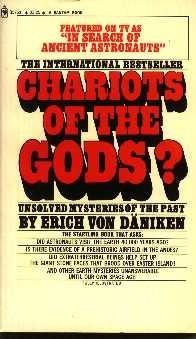
That was 1950. The Genesis Flood was 1961. And a decade after that, Erich von Däniken published his best-seller, called Chariots of the Gods?  Once again, the Bible figured prominently, but this time with God’s presence as mis-remembered and mis-reported visitations by ancient astronauts. And the only thing standing in its way was archaeology.

Yet while the colliding worlds astronomy scenario has all but vanished, young-earth creationism and the ancient astronauts are very much still with us. Creationism’s biology scenario is touted in evangelical churches across America, and the ancient astronauts archaeology scenario is touted on The History Channel. Approximately as any people believe it as believe creationism, and we have no idea how much those 40% or so of Americans overlap with one another. 

It’s not simply the rejection of science, but the arrogant construction of a different science, based in some measure on an idiosyncratic interpretation of the Bible. That is what connects the colliding worlds, young-earth creationists, and ancient aliens.  And one thing seems clear: arguing over whose story is right is not a successful strategy. “You” may believe that the planets have been more-or-less as they presently are for billions of years, but “we” believe that Venus is only 3500 years old. And why are you trying to disabuse us of that? Don’t we have a right to believe it? Come to think of it, aren’t you just being an intolerant archaic throwback to colonialist hegemonic practice?

The joint possession of secret knowledge is, after all, a pretty obvious form of social bond.  People who believe the Jets are going to the Super Bowl have something to agree on and to hope for together, regardless of any basis it might have in reality.

Would it give you pleasure to try and convince them otherwise? To me, that's a bit sadistic. I agree rather with H. L. Mencken, who said something like: Everyone is entitled to the belief that their spouse is attractive and their children are smart. 

Talking people out of their delusions can be fun, don't get me wrong. I just don't think it should be the goal of science education. It's one thing to teach what scientists believe, and quite another to insist that everyone believe as you do. 

Instead, we should be focusing on how scientific stories get made, and why their odd beliefs aren’t science. How do we explain appropriate scholarly practice to those who have never experienced it? That's the pedagogical challenge. But this is the complementary intellectual domain of the humanities:  turning the conversation away from the content of the science itself, and towards the nature of scientific epistemologies. That is to say, what makes something scientific knowledge as opposed to unscientific knowledge.

And sure, if you want to go for broke, why, in most contexts, scientific knowledge is more reliable than unscientific knowledge.

But this will necessarily be a humanistic conversation, and it may not be one that scientists are comfortable with, but it is probably a conversation that has a better chance of making a difference than just insisting that they’re wrong and you’re right.

Or, to put it in the non-scientific domain of morality: Don't be an asshole.

Wednesday, June 23, 2021

The Good, The Bad, and the Scientists Who Don't Know the Difference

     One of the things I’ve been giving a bit of thought to, as I begin to contemplate retiring and not doing the stuff that I’ve been doing for the last few decades, is the biggest gap in my own education. I take no responsibility at all for the gap, for it is totally not my fault: I am the victim of a good science education that gave me no moral education. Like other scientifically-trained scholars, moral arguments intimidate me, I don’t know how to construct them and I don’t know how to evaluate them. I just know, like other scientists, that I’m good and I'm right and that you are a fucking asshole for doubting it.

    Looking back on the beginning of my career, which is what one does at this stage, I realize that there were three things I was most concerned with thirty years ago, aside from my actual lab research. These were questions involving:

(1) Racist science  

(2) Dishonest science

and

(3) Colonial science

    In retrospect, all three of these were linked by the moral question in science. Right and wrong, good and evil.  But having no background in philosophy or theology, I lacked the intellectual framework to understand my own interests, much less any vocabulary with which to describe them. The point is that scientists are expected to develop into moral beings without any education in it, which seems opposed to the rest of both education and the history of our species.

    Yet the public positions I adopted early in my career, which made me a dangerous radical to the older farts in physical anthropology, aren’t so radical any more, at least within contemporary biological anthropology. But some of our colleagues in cognate fields are a bit behind us, and it can be very frustrating to argue about basic moral issues with biologists, who have as little training in the subject as I do. Many of them, after all, spend their lives torturing vermin like fruit flies in order to unravel the mysteries of life. Is it worth it? Sure, ok, yeah, torment the damn flies for the good of science. 

    Back in 1871, John Murray in London published a very important two-volume work on human ancestry. The intellectual times and context were important. There was an important question out there, being debated by first-generation evolutionary biologists.  The Bible clearly states that Adam and Eve were placed in a garden, to till the field. Where, then, did hunter-gatherers come from? Were modern foragers degenerate descendants of the biblical horticulturists? Or were the foragers primordial, and the biblical story simply wrong?

    That question had been definitively answered by Darwin’s neighbor, John Lubbock, in his Pre-Historic Times (1865). Those times had been times of foraging, and they preceded agricultural times.  But that raised a second question: What of the living hunter-gatherers? What’s the matter with them? Why are they even there? The first Darwinian answer to that question came from the German Darwinian, Ernst Haeckel, in 1868. To Haeckel, the difference between the “savage” and the European was zoological. They were different species altogether.  In fact, Haeckel argued, savages should not even be classified with people; they should be classified with apes. But don’t take my word for it. Here's the English translation of 1876.

If one must draw a sharp boundary between them, it has to be drawn between the most highly developed and civilized man on the one hand, and the rudest savages on the other, and the latter have to be classed with the animals.

Lovely guy, Haeckel. And a great Darwinian. A credit to his field. Remember that line when you admire his artwork. Now his explanation for the existence of savages has a lot of biopolitical implications, which we need not dwell on here. Suffice it to say that it was not regarded as a very satisfactory answer in much of the rest of the scholarly community. 

    The next year, 1869, another first-generation Darwinian took a crack at the question: Why were there still savages?  Alfred Russel Wallace acknowledged that savages were smart. In fact, he reasoned, they were too smart. The savage has a brain as large and powerful as that of an Englishman, reasoned Wallace, but the savage doesn’t need it. It doesn’t take much brains to be a savage. And yet the savage has a brain. Moreover, most of human prehistory involved brainy savages, who evolved by natural selection. And yet, natural selection can’t make an organ that the body doesn’t use. So if apes evolved into savages, that process must have involved the acquisition of a big brain that natural selection couldn’t make because the savages don’t need or use it. 

    So if natural selection didn’t produce the big powerful brain that separates savages from apes (and allies them with Europeans, contra Haeckel) then what did produce that big unused brain?

The brain of pre- historic and of savage man seems to me to prove the existence of some power, distinct from that which has guided the development of the lower animals through their ever-varying forms of being.

You know what produced it. And Who. It was a miracle. From God.

    Charles Darwin wrote to him, “I hope you have not murdered too completely your own and my child.”

    So by 1870 the Darwinians were batting 0 for 2 in trying to explain the evolutionary relationship between savages and civilized people. Which brings us up to 1871 again, and the publication by John Murray of that very important two-volume work on human ancestry. Of course the author was Edward B. Tylor and the book was Primitive Culture.

    What Tylor did in Primitive Culture (1871) was to give yet a third explanation for the difference between the savage and civilized person. It was not a distinction of biological evolution, as Haeckel had it in 1868. Nor was it a distinction of supernatural evolution, as Wallace had it in 1869. Nope, in 1871 it was a distinction of cultural evolution. That was the correct, and ultimately paradigmatic, answer.

    Also, Darwin published The Descent of Man that year. And sadly, it doesn’t stand up much better under a modern reading than Tylor’s Primitive Culture does. They’re both quaint, insightful, and important in their time and place, and dated now. But what makes them all of those things? Graduate students should definitely try to find out with careful, critical readings.

    And that brings me to the direct inspiration for this rant. A few weeks ago, Agustín Fuentes, with whom I agree on the great majority of things I hold a professional opinion about, published an editorial in Science. Science is the leading scientific journal in America, and a guest editorial in it is way up high on the prestige scale. You can bet they vetted the essay pretty carefully. And they published it with some of Fuentes's pretty uncontroversial assessments, like these.

“Descent” is often problematic, prejudiced, and injurious. Darwin thought he was relying on data, objectivity, and scientific thinking in describing human evolutionary outcomes. But for much of the book, he was not. “Descent,” like so many of the scientific tomes of Darwin's day, offers a racist and sexist view of humanity....

Today, students are taught Darwin as the “father of evolutionary theory,” a genius scientist. They should also be taught Darwin as an English man with injurious and unfounded prejudices that warped his view of data and experience.

No book on any science from 1871 stands up scientifically today. If you read a science book from 1871 you are probably reading it because someone told you it was important, and maybe it was. But you will have to probe to find what identifies it as a classic, and while you get there, you will struggle through the intellectual primitiveness of the work itself. And it will hopefully be a rewarding exercise, and then you can go back to reading the pdfs on line of the articles that aren’t even published yet in your favorite journals.

    Alas, there are some scientists out there who don’t countenance any critical reading of Darwin. Any criticism of Darwin is fodder for creationists, and therefore he must be defended at all costs. Which is pretty much what the Darwinian All-Stars managed to splutter out in their angry letter to the editor

    But first, let's go over the Darwinian All-Stars lineup. Leading off? Psychologist Andrew Whiten. Second, Walter Bodmer. That's right, Sir Walter Fucking Bodmer. Third, the geneticists: Brian and Deborah Charlesworth and Jerry Coyne. Next, psychologist Frans de Waal. And then six more of them, because, one supposes, something about group selection. And what is their top complaint?

We fear that Fuentes’ vituperative exposition will encourage a spectrum of anti-evolution voices... 

    Now if you bothered to read Fuentes's essay (and here's the link again), you may be puzzled by their use of the adjective "vituperative". Let's just assume for the sake of parsimony that they don't know what the word means.

    So anything that we perceive as critical of Darwin must be suppressed, because it may aid the creationists. That is about the most pathetic admission of abject failure on the part of science educators that I have ever encountered. These scientists have been so unsuccessful in convincing the American public we evolved from apes, that they are going to respond by placing Darwin on a pedestal and reading his 19th century sexist and colonialist views uncritically. Good lord, could they possibly sound more like a cult?

    Without belaboring the essay or the response, I want to shift back to the general moral question in science. I’m expending a little bit of mental energy here pondering what appears to be scientists trying to shield students from confronting sexism, racism, and colonialism in scientific literature. That is an amazing corner to paint yourself into, rather like being anti-antifa, which would seem to be the equivalent of pro-fascist. 

    But to return to the moral question. While Darwin was rewriting the Journal of Researches (aka The Voyage of the Beagle) there was a lot going on politically, and the 1845 second edition contains a digression about how slavery really and truly sucks: 

if the misery of our poor be caused not by the laws of nature, but by our institutions, great is our sin... It makes one's blood boil, yet heart tremble, to think that we Englishmen and our American descendants, with their boastful cry of liberty, have been and are so guilty: but it is a consolation to reflect, that we at least have made a greater sacrifice, than ever made by any nation, to expiate our sin.

And folks have from time to time, trotted out that passage to show what a socially concerned and morally advanced fellow Darwin was.

    But let’s look a bit more closely at that thought. I think we would agree with Darwin (and even with his imaginary interlocutors, who are trivializing slavery by comparing it to mere poverty) that if the misery of the poor is due to our institutions, then great is our sin. But let’s turn the thought around. Suppose the misery of the poor is indeed actually due to the laws of nature. Then what? Fuck them and their misery, because at least we haven’t sinned?

    Darwin’s moral thinking here isn’t very moral at all. It’s weirdly amoral. The point Darwin is making is that slavery is much worse than mere poverty, no matter how much some people may try to equate them. Fair enough. But isn't there a problem with poverty too? The proper reaction to the misery of the poor is to work to alleviate it, not to try and figure out who to blame for it. Darwin is less concerned with the suffering and misery of the poor than he is about the cleanliness of his own soul, and perhaps that of his entire economic class (“our”).  And here is the moral problem for future generations: If the issue is who caused the misery, not how do we alleviate the misery, then that places a scientific premium on showing that at least you aren’t the cause of that misery.

    Which is why Charles Davenport blamed genes, C. C. Brigham blamed IQ scores, and Charles Murray blames them both. The important thing is to somehow blame the misery of the poor on “the laws of nature,” rather than on “our institutions”. For then, not only is “our” social class blameless, but we have used science to answer the unthreatening question we posed, yet actually done nothing to alleviate the suffering of the poor, regardless of why the fuck it’s there.

    The suffering is the problem, its etiology is secondary.

    That is a moral statement, however, and I don’t know how to defend it. Which is why I’m angry at my scientific education. And from the look of things, at a lot of other people’s scientific education as well.

    But this is funny. What had gotten me interested in scientific fraud was the DNA hybridization work of Sibley and Ahlquist back in the 1980s. Sibley is long dead, but Jon Ahlquist only expired recently, and his passing was noted ruefully by the creationists. You see, after a career falsifying data and committing scientific sins, it seems as though Ahlquist gave his life to Jesus, to absolve himself and atone for them.

    Well, that was convenient.