Saturday, May 31, 2014

Wade, weighed


            There are three interesting differences between Nicholas Wade’s new book A Troublesome Inheritance and The Bell Curve by Herrnstein and Murray twenty years ago.  The first is that The Bell Curve really did try to make itself look like science.  Herrnstein was a real psychologist, and it was a big fat book with statistics and graphs.  And several critical volumes later, we know that it was bullshit from top to bottom.

               Nicholas Wade’s A Troublesome Inheritance, by contrast, doesn’t even try to pretend to be science or to look like science.  It is purely a work of the second- (and sometimes third-) hand:  Here is a scientific conclusion I heard about.  Wade even tells the reader that the second half is "speculative,"  which makes it sound as if the book belongs in the genre of racist sci-fi.

               The second difference is that The Bell Curve took us all more or less by surprise, because we thought that we had put to rest the nested set of falsehoods that ideologue psychologists like Arthur Jensen had been saying even earlier in the century: that IQ measures an innate, linear and generalized brain force that some people have more of and some people have less of;  that IQ is largely determined by one’s genetic constitution; that since some groups score worse than other groups on IQ tests, it means that they are genetically condemned, on average, to be less intelligent.  Actually, it turns out that although isolated for decades in an intellectual racist ghetto, those kinds of things were still being said; and The Bell Curve cited over twenty papers each by Arthur Jensen, and by that new scientific racist on the block, Phil Rushton.  A Troublesome Inheritance, by contrast, was being promoted months in advance; and although the scientific community didn’t get advance copies as quickly as the white supremacists did, we did have some prep time, so that we didn’t have to be totally reactive after its publication. 

               The third difference is possibly the most important, and it is that Nicholas Wade’s book is coming out in the age of the internet and social media.  Back in 1994 there were a lot of naive reviewers who said, “Well, this sounds fishy, but it seems true, and these guys seem to know that they’re talking about....”  But in 2014, any reviewer who wants to be minimally conscientious has ready access to some quick and strong critical responses to the book.  I wrote two of them: one for In These Times, and one for the American Anthropological Association, which came out in the Huffington Post.
  
             Agustín Fuentes had his critical comments in Psychology Today and the Huffington Post, and debated against Wade on a AAA podcast, showing pretty clearly that Wade did not know what he was talking about, and has egregiously misrepresented the state of scientific knowledge about human diversity.  Alan Goodman  had his critical comments published in Counterpunch.  And Jennifer Raff, a post-doc who actually works on the DNA of ancient human populations, wrote a strong critique on her blog and the HuffPost.  The point is that there are substantive criticisms out there on the web for naive, or just curious, reviewers and readers to draw on – which weren’t so easily accessible immediately after the publication of The Bell Curve.

Yes, conspiracy nuts.  That would be me and Alan Goodman presenting Ashley Montagu
with the Darwin Award from the American Association of Physical Anthropologists, circa 1994.
  
             I think this has had an effect, because there aren’t too many reviews out there saying that Wade’s rubbish is erudite and sounds possible and darn it all, just might be true.  There was one early one, I think.  You’ve got the positive reviews by political radicals and by the political theorist who co-authored The Bell Curve, and a couple of graduate students in evolutionary psychology who will probably be wishing they had known a lot more about the subject before posting that review, when they eventually hit the job market.  And then you’ve got the negative reviews by everyone else.  Geneticist H. Allen Orr.  Geneticist Jerry Coyne. Sci-tech writer Ian Steadman. Biological anthropologist Eric Michael Johnson. Biologist P. Z. Myers.  Writer Patrick Appel.  Science writer Pete Shanks.  Editor Brian Bethune.  The X.  Arthur Allen.  Science historian Nathaniel Comfort.  

               Now, in an act of apparent desperation, Mr. Wade is taking on his critics.

               Let us review the main points of the book, shall we?
  • ·        Racism is bad, and there have been abuses of science in the past.
  • ·        Everybody else sees human variation as a bio-political issue, but it really isn’t.
  • ·        Modern scientific views about human variation are politically correct myths produced by Marxist anthropologists, who are stifling serious discussion of human variation.
  • ·        The human species really does come naturally divisible into a fairly small number of fairly discrete kinds of people, or “races”.
  • ·        These races have genetic distinctions that cause personality distinctions.
  • ·        So do economic strata and nations.
  • ·        Global geo-political history has a significant genetic component.

(Just to show you I’m not making this up, Wade actually purports to be exploring “the possibility that human behavior has a genetic basis that varies from one race to another”; “trust has a genetic basis”; and “national disparities in wealth arise from differences in intelligence”.)   

               The idea that there is a conspiracy to prevent discussing human diversity within the academy is particularly bizarre, since that has been a regular – indeed, central – part of the curriculum of biological anthropology for many decades.  After The Bell Curve, the American Anthropological Association and the American Association of Physical Anthropologists produced position papers on race, so that the public could know what we have learned about it, the state of the science of human variation, so we can move on.

               Wade dismisses both statements categorically.  Even if they summarize the data and scientific knowledge that we possess, they are, says Wade, the products of politically deluded minds.  Unlike his.

               Wait a minute, isn't that a political statement?

               Interestingly, though, the most positive reviews of Wade’s book have come from political extremists, of the sort that you wouldn’t want to invite to family reunions.

               Makes me wonder whether his claim to political neutrality is just amazingly stupid, or a simple lie.  For what it’s worth, history can sometimes be illuminating:  the paranoid claim that you can’t talk about human variation on campus because of the commie thought-police was put out there first in the early 1960s by the segregationists; then revived by Jon Entine in his horrid 2000 book, Taboo:  Why Black Athletes Dominate Sports and Why We’re Afraid To Talk About It; it isn’t even original with Wade. 

               The taboo on race in the study of human variation is directly parallel to the taboo on creationism in the study of human origins.  We used to think it was true, we now know differently, and to talk about it today marks you as someone who is ignorant of the science, and is irrationally committed to an outmoded and  false understanding of biological anthropology. 

               What does Wade have to say in his defense?

It takes only a few vigilantes to cow the whole campus. Academic researchers won't touch the subject of human race for fear that their careers will be ruined. Only the most courageous will publicly declare that race has a biological basis. ... The understanding of recent human evolution has been seriously impeded, in my view, because if you can't study the genetics of race (a subject of no special interest in itself), you cannot explore the independent evolutionary histories of Africans, East Asians and Europeans.

There is an element of truth to that.  It’s not in the accusation of vigilantism, since the position opposite to Wade's is the normative position of the community of scholarly experts.  It’s not in the courage to talk about race as a natural category (“has a biological basis” is a vacuous statement, since there is a biological basis for everything; the scholarly issue is whether races are primarily categories of nature or of social history).  It’s the last statement that contains the element of truth.  And it’s not in the first clause; the study of the genetics of race is an old research program in biological anthropology, and I’ve written about how it killed itself off.  No, it’s in the thought that “you cannot explore the independent evolutionary histories of Africans, East Asians and Europeans.”  If you believe that there are “independent evolutionary histories of Africans, East Asians and Europeans” then you misunderstand human evolution, for human histories are not independent of one another.  They may be separate to varying extents, but they are also biologically connected in all kinds of interesting ways, and if you aren’t prepared to acknowledge that, then you don’t know enough to be taken seriously.  Nor are they units of nature, to be taken for granted.  The idea that the continents somehow represent natural units of human biology is empirically false, and when you read up on the history of the continents – the intellectual history, not the geological history – you quickly see how it could not be otherwise.

The attacks on my book come from authors who espouse the social science position that there is no biological basis to race.   It is because they are defending an ideological position with a counterfactual scientific basis that their language is so excessive. If you don't have the facts, pound the table. My three Huffington Post critics -- Jennifer Raff, Agustín Fuentes and Jonathan Marks -- are heavy on unsupported condemnations of the book, and less generous with specific evidence.

               Speaking just for myself, all of my condemnations of the book were entirely supported.  There is hardly anything I’ve enjoyed more in the last few months than quoting this horrid anti-intellectual book to my friends.  Why?  Because I think Wade can speak for himself, and when he does, you hear words that are familiarly ignorant and racist.  I don’t like ignorance and racism, and correcting them is kind of my job.

Despite their confident assertions that I have misrepresented the science, which I've been writing about for years in a major newspaper, none of these authors has any standing in statistical genetics, the relevant discipline. Raff is a postdoctoral student in genetics and anthropology. Fuentes and Marks are both anthropologists who, to judge by their webpages, do little primary research. Most of their recent publications are reviews or essays, many of them about race. Their academic reputations, not exactly outsize to begin with, might shrink substantially if their view that race had no biological basis were to be widely repudiated. Both therefore have a strong personal interest (though neither thought it worth declaring to the reader) in attempting to trash my book.

               There is a self-interest at work, but it’s the same self-interest that we have vis-a-vis a creationist.  We have devoted our adult lives to understanding the subject of human origins and diversity.  The only appropriate way for you, as an amateur, to challenge the authority of science on the subject is to show that you know more than your biological anthropology interlocutors, not to impugn their scholarly credentials (that you have none of, in any event).   It’s also weird, again, coming from the standpoint of scholarship, that Mr. Wade is first discovering our work, from our webpages, and that “many of [our publications] are about race”.  Then I must say that I find it odd that he didn’t read them before he published a book on the subject

               And hey, when did statistical genetics – which Mr. Wade doesn’t speak for, anyhow – suddenly become the only relevant intellectual area?  The fact is that statistical genetics doesn’t support Wade – as indeed the history of the statistical genetical study of human diversity, and the work Wade himself cites, both show.   Wade makes reference to the 2002 study in Science that used a computer program called Structure on the human gene pool. 

Raff and Marks take issue with one of these surveys, which used a computer program to analyze the clusters of genetic variation. The program doesn't know how many clusters there should be; it just groups its data into whatever target number of clusters it is given. When the assigned number of clusters is either greater or less than five, the results made no genetic or geographical sense. But when asked for five clusters, the program showed that everyone was assigned to their continent of origin. Raff and Marks seem to think that the preference for this result was wholly arbitrary and that any other number of clusters could have been favored just as logically. But the grouping of human genetic variation into five continent-based clusters is the most reasonable and is consistent with previous findings. As the senior author told me at the time, the Rosenberg study essentially confirmed the popular notion of race.

               Two fairly big things wrong there.  First, Wade's unscientific reasoning, which is quite different from that of the authors.  Wade says that since the runs for K<5 and K>5 yield racial nonsense, then we should accept the run at K=5 as being racially meaningful simply because it fits in with his a priori notion of human diversity.  If that logic had been used in the paper itself, it would not have been publishable. The correct conclusion is that unless you have a better (i.e., independent) reason, you have to assume that the result at K=5 is just as racially nonsensical as the rest of them.  In science, we don’t juggle variables until we find a result that we like and then say that it is correct because we like it.  Second, “the senior author” was Marcus Feldman of Stanford, whom Wade indeed quoted in 2002 in the Times: "Dr. Feldman said the finding essentially confirmed the popular conception of race.”  Except that I’ve heard Feldman specifically deny having said that to Wade, claiming he was abjectly misquoted there. 


               In fact, it was at the very conference that inspired Deborah Bolnick to write her trenchant critique of the racial abuse of Structure.  So I don’t think Wade knows the statistical genetics, quite frankly, any more than he knows the biological anthropology. Geneticist Jeremy Yoder is none too satisfied with Wade's treatment of the Structure work, either.

               I honestly also don’t think that the ontology of race is the most important stupid idea in the book – it’s kind of a red herring beside the stupider idea that the industrial revolution in England was driven by the genes for “nonviolence, literacy, thrift, and patience” that Wade imagines to have arisen as mutation in the upper classes in the Middle Ages, and then diffused by gene flow into the lower classes.  As I mentioned above, even Wade tells the reader that he's speculating, in which case we either judge it as science fiction, or place it in context of all of the other genetic theories of history that have been proposed and rejected.  

               But let’s return to try and make some sense of what Wade means by “race” in his rebuttal. 

[R]aces are not and cannot be discrete ....  In fact, the races are not demarcated at all. They differ only in relative allele frequency, meaning that a given allele may be more common in one race than in another. ...
             Humans cluster into five continental groups or races, and within each race there are further subclusters. So the number of human races depends on the number of clusters one wishes to recognize.... [T]his has no bearing on whether or not races exist.

               Once again, there is truth here, but Wade can't identify it.  There is geographic structure in the human gene pool, but that is not race.  There, I said it.  I’ve said that every semester for thirty years.  Nobody denies that there is geographic structure in the human gene pool.  But if you call that “race” then you are using the word “race” in a new and heretofore unprecedented way.  It's similar to the way some geneticists were redefining it in the 1960s, but then realized it was intractable. Why?  Because if the only factor that determines the number and kinds of clusters that you see in the human gene pool is how closely you examine it, then race (as genetic cluster) is not a natural feature, but a bio-cultural construction.  The most relevant variable is simply the scope of your analysis, which is arbitrary.  The genetic clusters are real, but there's no sense in calling them races.  They're just arbitrarily-sized clumps of allele frequencies.  Or, for lack of a better word, "populations".  

               What’s the alternative?  That the human gene pool is homogeneous?  No anthropologist has ever thought that.

               The lesson here is a basic one at the undergraduate level in biological anthropology: Discovering difference is not race; discovering geographic difference is not race; and if race is all you can think about, then you aren’t going to get very far in understanding the nature of the human gene pool.

               But as I said, I think race is a bit of a red herring here, since when all is said and done, the only people who merit their own chapter in Wade’s book are the Jews.  And yes, we do have a lot of familiarity in the history of anthropology with people who are obsessed with race and with Jews.  We can just add Mr. Wade to that list of unscholarly writers who don’t know the modern data or literature on human diversity, and who mistake their feelings and prejudices for thoughts. 

               So who actually likes Wade’s book anyway, aside from Charles Murray, some snot-nosed evolutionary psychology students, and the white supremacists?  I suspect that even other elitist Etonians are running away at full stride, rather than be caught in such company.

Sunday, May 25, 2014

Science imitates art?

Once you deflect the accusation that a cabal of Jewish commie anthropologists is stifling discourse on human variation and that there really are just, like, four kinds of people – there really is an interesting question lurking behind all the nonsense.  Namely, if there really are, say, four  kinds of people out there, then how come nobody noticed it until 1684?  That’s the year that François Bernier, French physician and traveler, anonymously published the idea, in an early scientific journal, that there is a correspondence between a para-continental region and a particular kind of person.  Until then, European scholars had been content to see human variation as patterned  locally.

     Bernier’s idea passed largely unnoticed, but within a few decades that is precisely what the naturalist Carl Linnaeus and the philosopher Immanuel Kant were teaching about the human species.  What made the previously hidden pattern within the human species  suddenly so obvious?
     We generally point to three things that combined to construct this scientific fact (in spite of its empirical falsehood).  First, long voyages by sea, rather than over land.  By land, like Marco Polo, one tends to be struck by human continuity and local variation.  But by sea, one can be struck far more readily by the discontinuity between the people you left behind three weeks ago and the people you are encountering now, in the rest of the world in the 17th century.  This would promote seeing human variation as discontinuous.
     Second, the encounter with unfamiliar and fluid social and political forms, often strikingly different from the carefully regulated borders and centralized governments familiar to Europeans.  This would promote seeing large groups of people as essentially homogeneous.
     And third, the development of science as a source of authoritative knowledge.  Science, to some extent, begins with collecting, organizing, and systematizing the diverse things one encounters in the universe.  The natural history that swept across the European academy in the 18th century was predicated on precisely that kind of work, spearheaded by the Swede, Carl Linnaeus.  For Linnaeus, the most fundamental question was always “How many kinds of something are there”?  There were several kinds of mammals, of which one was Primates; four kinds of Primates (Homo, Simia, Lemur, and Vespertilio  [the bat]), two kinds of Homo (sapiens and troglodytes), and four kinds of Homo sapiens (americanus, europaeus, asiaticus, and afer).
     Clearly, Linnaeus was wrong about a lot of things.  But he did develop modern biology, which is why his face is on Swedish money, and yours isn’t.


     Yet of course the idea, whether to Bernier, Linnaeus, or Kant, didn’t come out of nowhere.  It turns out there was a sort of idea that the people of a single continent could be embodied in a single image, except that it was intended entirely allegorically, and not to be taken literally.  And that was 17th century cartography.
     Before the discovery of America, world maps sometimes depicted the three known great landmasses.  But they didn’t tell you that there was a kind of person associated with each one.  The closest you could get was the idea that three sons of Noah – Ham, Shem, and Japheth – went forth and founded the peoples of Africa, Asia, and Europe, respectively.  But that didn’t go very far as a narrative of human differences, since they were all old Middle Eastern men, and brothers, to boot. (Around the world are the winds, and to the left are monstrous peoples.)


     By the late 16th century, after the discovery of America, mapmakers begin to embellish their maps with images of people.  In this 1577 map by Gerardus Mercator, the figures in the corners are actually allegories of the elements of which the universe is composed: Earth, Air, Water, and Fire. 


     In fact, they are not just personifications of the elements, but embodied by the Roman gods, with Jupiter and Neptune on the left.  (I'm guessing Juno and Ceres on the right.)   But only a few years later, this 1592 map by Petrus Plancius is filling the corners with different information. 

     Yes, those are images of women, symbolizing the continents, with some of the trappings of the continent, and some of its native beasts, one of which is a kind of chair for the Continent-person.  America (which he calls Mexicana) sits on an armadillo, Africa is on a crocodile, Asia rides a rhino.  Only Europe is not seated on an animal, but eats from the Horn of Plenty.  (There are some bulls in the background, the bull associated with Zeus's visit to the continent's namesake.)
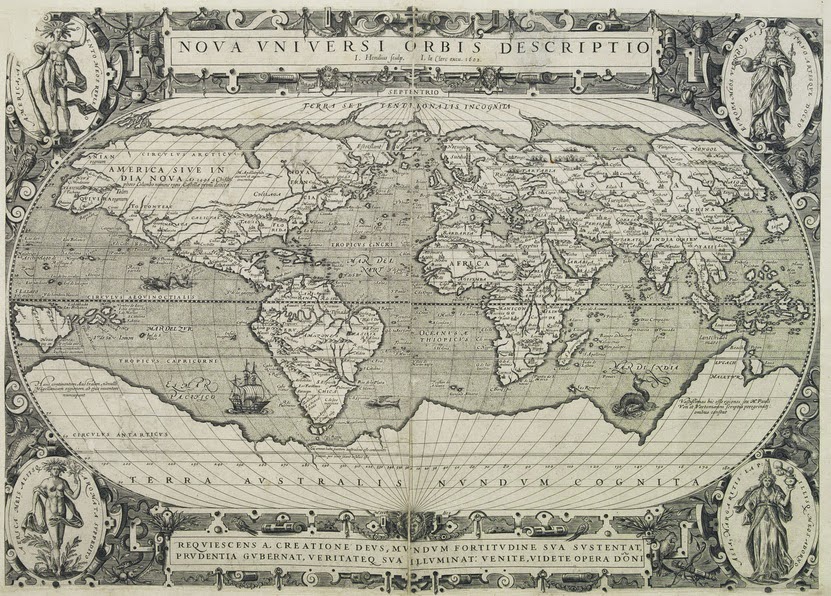
     Likewise, in this 1602 map by Hondius.  Now the  corners are filled with images of women representing the continents themselves.


And here are the women.


     Likewise, in this 1638 map by his son, Hondius.


     And close-ups of the people embodying the continents.  There's Europe, with her horse, stag, and horn of plenty.


And Asia, with a camel, some incense, and the wealth of the orient.


And there's Africa, uncovered and with an elephant.


And finally, America, feathered, and about to shoot an alligator with a bow and arrow.


     That was kind of cool.  Here's a 1652 map bClaes Janszoon Visscher.  He's got pictures of the Roman emperors at the top and bottom.  In the corners are the female personifications of the continents.


Interestingly, and quite uniquely, he doesn't stop there, for in addition to the female allegories, he also shows you what people look like.  Here are the Europeans (from Amsterdam), Asians (from Jerusalem) , and Africans (from Tunis) on the left side of the map.  And on the right are images of north, central, and south Americans.  The point is that he is communicating two things simultaneously: allegorizing the continents as female figures, and showing you what the actual people on the continents ostensibly look like.
     Here is a 1670 map by Philipp Cluver, or Cluverius (who died in 1622; they reprinted these maps quite extensively.).  Once again, you can see images in the corners embodying the continents and to some extent racializing them.


Here are the corner images, personifying the continents.  That would be Asia with her camel, Europe with her bull, America with something in a tree, and Africa with a lion.


One last one.  This 1676 map by Robert Greene.  Once again, the corners are images of the people of the continent.


     Yet all of these maps are earlier than François Bernier’s 1684 scientific paper, on a new division of the earth, beginning the unification of its continents and its human types.  The difference is that the scientists actually took it literally, while the mapmakers initially intended it as art – a simple allegory.
     By the time of Linnaeus’s first go at it, in System of Nature (1735), the image was already a familiar one.  Four continents, four kinds of people.


That would be whitish Europeans, reddish Americans, dark Asians, and blackish Africans.  He hasn't quite sorted out the color scheme, or the species - but he is pretty confident that there are four kinds of people, each associated with a continent.  He'll have that  done by the tenth edition of 1758.  And this will become science, because of Linnaeus's vast influence over systematic biology.
     But the image was there for the better part of a century in European cartography.  Each continent had its own person.  They just didn't intend for it to be taken so literally.  I think this is an example of science imitating art, by taking what was initially intended as an allegorical image, and having it become so familiar - and so reasonable, given the political historical relations I mentioned up top - that  it could be literalized and incorporated into the science of the 18th century.
     That is, of course, the scientific conception of the human species that Nicholas Wade promotes as modern, in his new book.


Wednesday, January 22, 2014

An early "Darwin Day" essay

On February 4, evangelist Ken Ham will debate television personality Bill Nye (“The Science Guy”) on the subject of creationism, at the Creation Museum in Petersburg, Kentucky.  It will be streamed live, and should attract considerable attention among those with an interest in the decline of modern civilization.

A public debate between non-experts is theater, not scholarship.  The debate is predicated on a critical misrepresentation, as if Creationism/Evolution mapped cleanly on to Religion/Science.  But it doesn’t.  Evolution is compatible with many theologies. 

Certainly creationism is religious, and evolution is scientific.  But aside from a bit of old revisionist  history, the judgment of modern historians and anthropologists alike is that science and religion can, and do, coexist peacefully for most people.  The reason is that science is a fairly narrow intellectual domain, consisting of a series of methods for establishing reliable knowledge about the natural world; while religion broadly encompasses social, experiential, and moral domains. 

Religion is so fundamentally an aspect of the human condition that, as scholars have realized for many decades, most people integrate religious beliefs and attitudes seamlessly into their daily lives.  The ancient Greeks had no word for it.  It’s not that they weren’t religious, it’s just that they didn’t separate and label it, as we do. 

Ritual behaviors extend beyond religion.  As football fans are well aware - with commercials for Bud Light invoking the old Stevie Wonder song “Superstition” – religious beliefs and attitudes hardly end at the outer side of the church door.  And as anyone who as ever shouted “stupid computer!” and smacked the side of their monitor knows, the attribution of sentient properties to inanimate objects – loosely called “animism” – is not limited to the formally demarcated religious domain.

Creationists today are a diverse lot.  Ken Ham represents “young-earth creationism”, rejecting not simply anthropology and biology, but geology and astrophysics as well.  That position existed back in 1925, when John T. Scopes was prosecuted for teaching evolution in Tennessee, and William Jennings Bryan held center stage as the nation’s leading spokesman for creationism.  But young-earth creationism was too dumb even for Bryan, who made it clear during the infamous trial that he accepted the great antiquity of the heavens and the earth.  He was an “old-earth” creationist.

A more recent version of creationism - “intelligent design”  - preaches neither an old cosmos nor a young cosmos, but presents simply a theology of negativity, whose adherents are united solely in their opposition to the naturalistic explanation of human origins provided by modern science.
But the modern conflict is complicated by two other factors. 

First, the cultural prominence of evangelical atheists, who would cast themselves not simply against creationism, but against religion more generally.  These people, however, imagine that religion is as narrow as science is – simply a set of alternative and false narratives about nature.  But these people do no favors for science, for its authority on natural matters does not extend to the cultural, ethical, spiritual, or esthetic domains.

Second, the mistake of lumping anti-vaccinators, climate-change deniers, and creationists into a single “anti-science” bin.  Nobody is “anti-science” – that person exists only in the mind of a paranoiac.  After all, Republican resistance to anthropogenic climate change is about business and money, not about theology.

Creationism is a poor representation of religion, whose basis is not merely an alternative narrative of our origins, but lies in the construction of a complex and very human social, emotional, and moral universe.  And atheism is a poor representation of science, whose methods were developed to study natural processes and make no sense when extended beyond nature – if indeed there is anything beyond nature, which science doesn’t, and can’t, know.

There are individual exceptions, of course, but Judaism holds that the Torah must be interpreted properly for every generation, and that only a poltroon would take it at face value.  The Catholic Church accepts the descent of the human species from earlier nonhuman species.  That leaves Biblical literalist creationism as a sectarian theological dispute within Protestantism.

It’s time to separate science from atheism, and religion from Biblical literalism.   The atheists and the literalists can slug it out, but the rest of us will continue trying to make decent intellectual sense of the things in our lives that science does explain and the things it doesn’t.

Saturday, November 2, 2013

Heads, We Win!

            The relationship between the head and the mind is a subtle one, and it has led generations of scientists into difficult straits.  The brain is inside the head.  Aside from Aristotle and his most devout followers (who thought the brain's primary function was to cool the body), nearly all ancient and modern European scholars have understood the brain's primary function to be in producing thoughts.  Yet different people have different thoughts - some bad, some good.  And some people have mental gifts - for mathematics, for art, for socializing.  Is it because they have different kinds of brains?  Is it because they have different kinds of heads?

            Perhaps we should look to science to find out.

            In the first half of the 19th century, one of the most popular applied sciences was known as phrenology, developed by medical anatomists.  It answered  the question, "Why do people have such different personalities?" by recourse to medical anatomy.  The logic, primitive if comprehensible, was that people have different personalities because they have different brains; the brain is composed of various modules for music, love, fidelity, and the like, and since the skull encloses the brain, we can read one's personal talents and abilities from the overdeveloped or underdeveloped parts of their brain, which are inscribed upon the surface of the skull.  Just as a home-wrapped Christmas present might contain a bulge for a part that is a bit too large for its box, so too does the skull have bulges corresponding to the overdeveloped parts of the brain governing particular personality attributes.  All we need to do, then, is to feel the bumps on your skull, and we can tell you about your latent abilities.

            By the latter part of the 19th century, this was generally looked upon scornfully by the mainstream anatomical community, which had its own crude logical practice.  Just as a large pancreas secretes more insulin, it stands to reason that a large brain secretes more thoughts.  Thus, people with large brains are more intellectually gifted than people with smaller brains.[1]  One of the strongest early advocates of this idea, Samuel George Morton of Philadelphia in the 1840s, was also a believer in phrenology.  And yet, it was not too difficult to find small-brained geniuses and big-brained dummies.

            Perhaps, then, the head's gross shape had something to do with it, in addition to the head's gross size and surface details, or perhaps instead of them.   Some people (and populations) had long heads; others had short, broad heads.  Standardized measurements and a pompous scientific vocabulary developed in the middle of the 19th century described long-heads as dolichocephalic and broad-heads as brachycephalic.  As descriptions of people, of course, they were fine, but as explanations for their histories and social conditions, they were nonsensical, even if scientifically mainstream.[2] 

            The early anthropologist Franz Boas began to debunk the value of head shape, for any other purpose than descriptive, by empirically contrasting the head shapes of immigrants with the heads of their children and other family members, and showing that this trait was heavily influenced by the environment.[3]  On the other hand, the early physical anthropologist Aleš Hrdlička wrote with dismissive condescension about phrenology, but when given the chance to examine the brain of a recently deceased Eskimo (Inuit) from Greenland, he leapt at the opportunity.  His 1901 paper on "An Eskimo Brain" was not followed by one on "An Eskimo Arm" or "An Eskimo Liver," so he clearly regarded the organ as one of especially great scientific interest.  It is not clear, though, just what he expected to learn from it, although he quite ghoulishly concludes, "The marked differences  ...  from those of the whites  ... makes a future acquisition of Eskimo brains very desirable."[4]

            By the 1920s, it had become clear that culture was not to be found inside people's brains, but rather, constituted a part of the environment that imposed itself upon people's brains.  This is not to say that all brains are identical, but like arms and livers, their differences are largely irrelevant to the question of why different groups of people behave as they do, or have the histories that they do.  In pathological cases, the structure of a brain might be interesting, but it functions pretty much the same way in all normal people, whatever language they speak, and whatever their social background, class, diet, traditions, or values may be.

            By the 1950s, the physical anthropologists had come around as well - to the recognition that measuring head size and shape had its uses, but none of them involved the question of why different groups of people think and act as they do.  The eventual apprehension of this fact was doubtless a consequence of the fact that the physical anthropology of the Nazis, like their human genetics, was not all that different from its American counterpart, and had to be fundamentally reconceptualized after World War II.[5] 

            The head studies, however, required admitting an exception to the guiding principle of anatomy: that form follows function.  The new physical anthropology,[6] christened by Sherwood Washburn in 1951, would finally follow the cultural anthropologists, and hold as axiomatic that variation in mental properties and functions is disconnected from physical variation in head form.  There is a wide range of variation in normal human heads, and a wide range of variation in normal human thoughts, and they only map on to one another in the grossest or crudest of ways.  You can't legitimately infer cultural difference from the observation of cranial difference, nor cultural similarity from the observation of cranial similarity.  The reason is that they are epistemologically disconnected, for cultural differences are the products of history, not biology. 

            Thus, heads are more-or-less interchangeable across the great bulk of our species, and the brains inside them can do pretty much what anyone else's brain can do, except in pathological or exceedingly unusual cases. Consequently, when we encounter a modern human skull in the ethnographic, archaeological, or fossil record, we are going to assume that it housed a normal modern human brain, just like yours and mine, and consequently was capable of thinking the full range of normal modern human thoughts, just like yours and mine.  That seems to be the best inference we can draw from two centuries of studying the anthropology of heads.


[1] There are still a few psychologists who maintain this.  Actually, however, the correlation of IQ with brain size is far lower than the correlation of brain size with body size.  In other words, big people tend to have big brains.  If it were true that brain size were a significant determinant of intelligence, then the smartest people on earth would be football linemen.
[2] Gould SJ (1981) The Mismeasure of Man. New York: W W Norton.
[3] Boas F (1912) Changes in the bodily form of descendants of immigrants. American Anthropologist 14: 530-562
[4] Hrdlicka A (1901) An Eskimo brain. American Anthropologist 3: 454-500.  This was the brain of Qisuk, one of the "New York Eskimos" whom Franz Boas convinced Robert Peary to bring to the Big Apple from the Arctic.  All but Qisuk's son died within a few months.  I discussed this in Chapter 8 of Why I Am Not a Scientist.
[5] Marks J (2010) The two 20th century crises of racial anthropology. In: Little MA, Kennedy KAR, eds. History of Physical Anthropology in the Twentieth Century. Lexington Books Lanham, MD: pp. 187-206.
[6] Washburn SL (1951) The new physical anthropology. Transactions of the New York Academy of Sciences, Series II 13: 298-304

Monday, October 28, 2013

Scars of human evolution, part deux

Physical anthropologist Wilton Krogman wrote a classic article in 1951 for Scientific American called “The Scars of Human Evolution,” back when you could actually make sense of the stuff in Scientific American.  It addressed half of human evolution: bipedalism.

Hard as it may be to believe, the evolution of our other most basic adaptation is under-theorized.  I refer to our symbolic mode of communication, language.   Language, which is coterminous with symbolic thought – if you can think it, you can say it – was an unusual and apparently very good evolutionary innovation.  It was so good, indeed, that it created physical problems that the human body had to solve secondarily in order to make it work, and to some extent never did solve fully.

First, it expanded our heads.  Symbolic communication requires a big brain, as well as an extended period of immaturity in order to learn how to do it properly.  It is so difficult that we hardly even appreciate how difficult it is.  From the bottom up, we learn what sounds make sense.  Are “s” and “sh” variants of the same sound, or different sounds?  What about “l” and r”? Or “r” and “rr”?  Or the “Ch” in “Chanukah” or the “Zs” in “Zsa-Zsa”?  Are they their own sounds, or some weird variants of “Hanukah” and “Cha-Cha”?  We also learn how to combine those sounds, and use them to refer to objects, or acts, or states.  We could call those combinations of sounds “lexemes,” but for the sake of simplicity, let’s just call them “words”.  We also learn how to combine those words in meaningful ways – to state, inquire, praise, predict, recall, using any of the myriad grammatical forms at our disposal.  And on top of all that, we learn intonation, sarcasm, and bodily gestures to go along with the rules of sounds, their correspondences, and combinations.  The price for all of this was a brain inside a baby’s skull that hardly fits through the birth canal.  And the solution to that problem was to make birthing social.  Where an ape squats and delivers, a human almost always needs to have someone else around.

Second, language reorganized our throats.  To make all of those sounds, our larynx is positioned lower down in the throat than it is in apes and babies, who cannot make those sounds.  The price we pay is that the passage of air into our lungs and of food into our bellies now criss-cross, which they do not in apes, which means that we can choke on our food far more readily than a chimpanzee can.  The solution is: Don’t eat so fast, and try not to breathe while you are swallowing.

Third, language not only worked over our throats and brains, but our teeth as well.  Catarrhine primates often have large, sexually dimorphic canine teeth, which they use as social threats and in the occasional actual fight.  Classic sexual selection theory holds that in species in which males actively compete for mates, they do so using their canine teeth.   In species where there is less competition for mates, because males and females pair off, the males and females have equal-sized canine teeth, as in the monogamous gibbons.  This is often invoked as evidence that sexual selection has been reduced in the human species, which may well be true.  The problem is that those gibbon canines, which are non-dimorphic, are also actually quite large.  Ours are non-dimorphic, but small.  Why?  Because it is really hard to speak intelligibly through large, interlocking canine teeth.  Ask any vampire (and see if you can understand their response).  The price for the reduction of the canine teeth was that our canine teeth are not going to intimidate other members of our own species, nor defend us against member of other species.  Good thing we started using tools.

And fourth, in addition to reshaping our brains, throats, and teeth, language also reshaped our tongue.   To make the sounds we do, our tongue became more muscular, rounded,  and enervated than an ape’s tongue.   For this the cost was quite severe.  An ape dissipates heat, as most mammals do, by panting.  But to use your tongue primarily for talking, it will require that your body produce another way of dissipating heat.  Our ancestors did that by loading up our skin with sweat glands, for evaporative cooling.   But evaporative cooling only works efficiently with bare skin; so our body hair had to get shorter and wispier than that of an ape. 


Walking and talking are what are most fundamentally human, and it is quite extraordinary that they rhyme. So the next time you choke, sweat, scream for an epidural, or reach for a weapon to protect yourself because you lack confidence in your teeth to protect you, reflect on the fact that our body parts are interconnected, and that language was such a good way to communicate that it screwed you up in so many other ways.   I didn’t mention it, but there is a fifth price as well for language:  having to listen to people who don’t know when to shut the fuck up.

Monday, August 19, 2013

The Empire Strikes Back

Some of you older folks may remember the case in which geneticist Therese Markow (then of Arizona State, now of UC-San Diego) bled a Native American tribe on the promise of studying diabetes, and then piggybacked some research on schizophrenia and population structure and history onto that promise; except that she didn't tell them about it and they didn't consent to it.  This had been "situation normal" in the field for decades, but in the wake of the Native American Graves Protection and Repatriation Act (NAGPRA, born 1990) and the Human Genome Diversity Project (HGDP, died 1996), it is no longer acceptable practice.

The Havasupai case helped to reframe the relationship between scientists and Native peoples, which had been tested by the HGDP, and which had relied for decades on the assumption that there was a gentleman's agreement between the geneticist and the tribe, and that the geneticist could say anything to get the genetic samples from the tribe, and after it was out of their bodies, it was the property of the scientist, who could then do pretty much anything with it, including research that the tribe had not agreed to, and trading samples to other labs for other research.  But no more.  

In April 2010, the lawsuit brought by the Havasupai against Markow's institution was settled out of court, and the tribe, the university, and the bioethics community were all satisfied with the results.  I wrote it up for Anthropology Today shortly afterwards.

Now that we have blown up the Death Star, however, the Empire is striking back.  Ricki Lewis, the author of a major textbook on human genetics, and thus with the potential to miseducate thousands of students in human genetics, now says that Teri Markow did not actually study schizophrenia, the investigation and report commissioned on behalf of ASU and the Havasupai was a smear job, and the charges against her were entirely false.

So we are compelled to revisit the case once more.  Think of Teri Markow as Alex Rodriguez, and yourself as Bud Selig.

Ricki Lewis carried out a literature search and discovered that Teri Markow never published on the genetics of Havasupai schizophrenia.  From this, she concludes that Markow never actually studied it.

Like the weapons of mass destruction in Iraq, the narrative that the geneticist sought schizophrenia genes in Havasupai DNA became established fact with the repeating. Soon the accounts of the case began quoting and citing each other, as if the original documents that held the truth didn’t even exist.

The trail of original documents is actually rather interesting.  The most significant document is the one produced by Arizona State's investigation at the end of 2003, known as the Hart Report.  Ricki Lewis dismisses it, because she has additional secret information:   

I’ve got more background than went into the blog, and based on it, I wouldn’t trust the Hart report.

Be that as it may, the Hart report was based on extensive interviews and paper trails, and was as comprehensive as could be expected, to the satisfaction of both the Havasupai and the university.  It discusses lots of other original documents, such as consent forms.  In fact, it tells us that in an interview with Markow in 2003, "Markow had indicated, during the course of the interview, that she had lost or misplaced the file containing the informed consents from 1991 on ...".  The dog ate my consent forms.

Another original document is a story that appeared in Phoenix Magazine in 2008 by Jana Bommersbach, which says,

Markow maintains to this day that she had permission to test for things other than diabetes and that her “proof” is the consent forms signed by some of the Havasupai who donated blood. She insists the project had two focuses: diabetes and schizophrenia.

So in 2008, Markow was saying that schizophrenia had been a research focus of hers, and in 2013 she is saying that it wasn't?  Or more precisely, in 2013 Markow is enlisting a shill in the genetics blogosphere to deny that schizophrenia in the Havasupai had ever been a research focus of hers?

Further, the Hart Report says:

Dr. Markow was funded by NlMH and NARSAD to study the role of genetic factors in schizophrenia, a psychiatric disorder "which occurs at a significantly greater rate among the Havasupai (7%) than in any other population (1 %). Interestingly, all cases of schizophrenia occur in lineages tracing back to a single man (a shaman or medicine man) who lived in the 1880's."

NIMH is the National Institutes of Mental Health, not a cartoon.   NARSAD is the National Alliance for the Research of Schizophrenia and Depression, now called the Brain and Behavior Research Foundation.  In other words, among the original documents are funded grant proposals for research on schizophrenia.

The NARSAD grant for 1990-1991 was a big one, but unfortunately, the dog ate that, too.  According to the Hart report,

Information was hard to obtain on this grant. It is our understanding that it was funded in the amount of $92,880.00 and provided funds for the blood collection, processing and analysis that led to the genetics studies undertaken at Arizona State University (and elsewhere)....

Dr. Markow submitted the letter of intent for this grant, which requested funds to "initiate a major research program on the etiology of schizophrenia in a unique patient population in Arizona," the Havasupai. ... She proposed conducting the research in two stages. The first stage was to involve the collection of data, and it was for this stage that she was asking NARSAD, the National Alliance for Research on Schizophrenia and Depression, for funding. She indicated that support for the second, more extensive stage would be sought from NIMH, the National Institute of Mental Health. We have uncovered no evidence to establish that this letter of intent, or other documentation associated with this grant proposal, was presented to the Havasupai.

The NIMH grant was for "Genetic Analysis of the Dopamine Receptor Gene Family" and provided funding for Markow from 1992 through 1995.  The Hart report says,

the two primary goals of the project were, first, to determine the amount of genetic variation present in the dopamine receptor gene family in the Havasupai and, second, to statistically analyze the data to determine if any genetic variation was associated with the development of schizophrenia.

Unfortunately, the dog ate that grant proposal as well.  Teri Markow had a very hungry dog.

So what of this bizarre blog post by this textbook author?  The research didn't get very far, and didn't come up with anything publishable, which is why Ricki Lewis did not find any publications on it.  But how on earth can anyone claim that there was no research?  When she asks rhetorically, "Why did articles twist events to seem as if she had intended all along to study schizophrenia?" the obvious answer is that because Markow had indeed been interested in studying schizophrenia, and had received grants to do it.

So I pointed that out to Ricki Lewis, and she responded:  "just because you are funded from a certain source with a disease name in its title does not mean that you are or are intending to do research on that particular disease."   

Read that again, slowly.  A major science textbook author is telling human genetics students that they can apply for cancer funding from, say, the National Cancer Institute, and get it, while not actually having any interest in cancer or performing any research relevant to cancer.  I think she's wrong.  In fact, I think the National Cancer Institute would consider that fraudulent.

Teri Markow herself jumped in, but didn't say, "No, we did not study schizophrenia" - which was presumably the point under contention.  Instead, she said blah blah blah:

First of all, the consent forms speak for themselves with respect to the breadth of studies. However, without sufficient and appropriate genetic variants, association studies of any disease are not possible. The first step therefore, with our funding, was to seek genetic variability that could be useful in studies of disease. While we did not find sufficient variability with the techniques available at that time to perform association studies, we at least were able to provide people with feedback about their health status with respect to diabetes, because the test for this is simple. Had there been sufficient variability for stringent association studies for any disorder, we could have proceeded. 

However, even if there had been the requisite variability, stringent diagnostic testing for schizophrenia would require a major effort, including lengthy interviews, that never could have gone undetected by the participants. This fact, plus the fact that I have never published a paper on schizophrenia in the Havasupai, answer your question quite definitively.

This is from someone who received hundreds of thousands of dollars in grant money to study the genetics of schizophrenia in the Havasupai, but came up with nothing publishable.  But whether they came up with anything publishable is not the issue, this issue was whether research was carried out on the topic, without the knowledge or consent of the Havasupai.  The latter clause has not been challenged; the Havasupai were not aware that their blood was being used for any studies other than diabetes.

Those of us of a certain age can remember the "non-denial denial" from Richard Nixon's office in the old days of Watergate. 

So I tried again: "What I am hearing is that Dr. Markow sought and received funding from an agency that focuses on schizophrenia, without any intention of actually studying schizophrenia, and ultimately performing no science related to that illness."  Neither Ricki Lewis nor Teri Markow responded to that.  I suspect that if Markow publicly agreed with it, she might be incriminating herself.

Teri Markow seems to have had little difficulty in obtaining research grants or faculty positions subsequent to the Havasupai case, and now studies Drosophila.  She is probably very nice, and I've never thought that she did anything worse than what was common practice at the time.  It was the common practice that was being challenged.

One of my favorite examples of that practice is from a puff piece that Time Magazine ran on the HGDP, in which Luca Cavalli-Sforza was trying to show himself off as a swashbuckler.  And as S. J. Perelman once said, no man ever buckled a better swash.

On one occasion, when Cavalli-Sforza was taking blood from schoolchildren in a rural region of the Central African Republic, he was confronted by an angry farmer brandishing an ax.  Recalls the scientist, “I remember him saying, ‘If you take the blood of the children, I’ll take yours.’ He was worried that we might want to do some magic with the blood."  (Time Magazine, 16 January 1995)

When people come after you with an ax, that is usually a clue that you have not received their voluntary informed consent.  That is why there is no HGDP anymore, and why Teri Markow now works on flies.

Bioethics serves to make scientists responsible social actors, especially if they don't want to be responsible social actors.  Time was, that a scientist could do anything they wanted to anyone they wanted, for any reason they wanted.  Now they can't.  The lesson we learned around the middle of the last century is that the progress of science is great, but when it bumps up against human rights, human rights wins, hands down.  That's a good lesson for genetics students to learn. 

And what is the author/blogger Ricki Lewis's stake in all this?  Why bother to revisit a dead issue, and mount such a preposterous defense of Markow's work?  Maybe she's one of those people still fighting the Science Wars, who thinks that bioethics is just a set of obstacles to scientific research.  She does seem to hold some unusual views about science: "Science has nothing to do with belief, it is about data and evidence."  Actually, science has a lot to do with belief; for example, if you believe that you can do science on people without their consent, then you don't get to do the science.